Basics course · Lesson 29 · Part 5 · Risk management
Why You Need a Stop Loss
At a glance
- Loss percentage and the gain needed to recover are not the same number.
- As losses grow, recovery becomes exponentially harder.
- A stop price should mark where your original idea is proven wrong.
In the last lesson, we learned that RSI crossing above 70 doesn't mean price has to fall right away. Indicators show probabilities, not certainties — there's always a chance your read on the market is wrong. That's why the first step in risk management is deciding in advance what you'll do if you're wrong. The answer is the stop loss.
A stop loss is an order that closes a losing position at a price you set in advance, so a loss doesn't keep growing. Without one, a small loss can turn into a large loss, and a large loss can become one that's extremely hard to recover from.
Loss and recovery are not symmetric
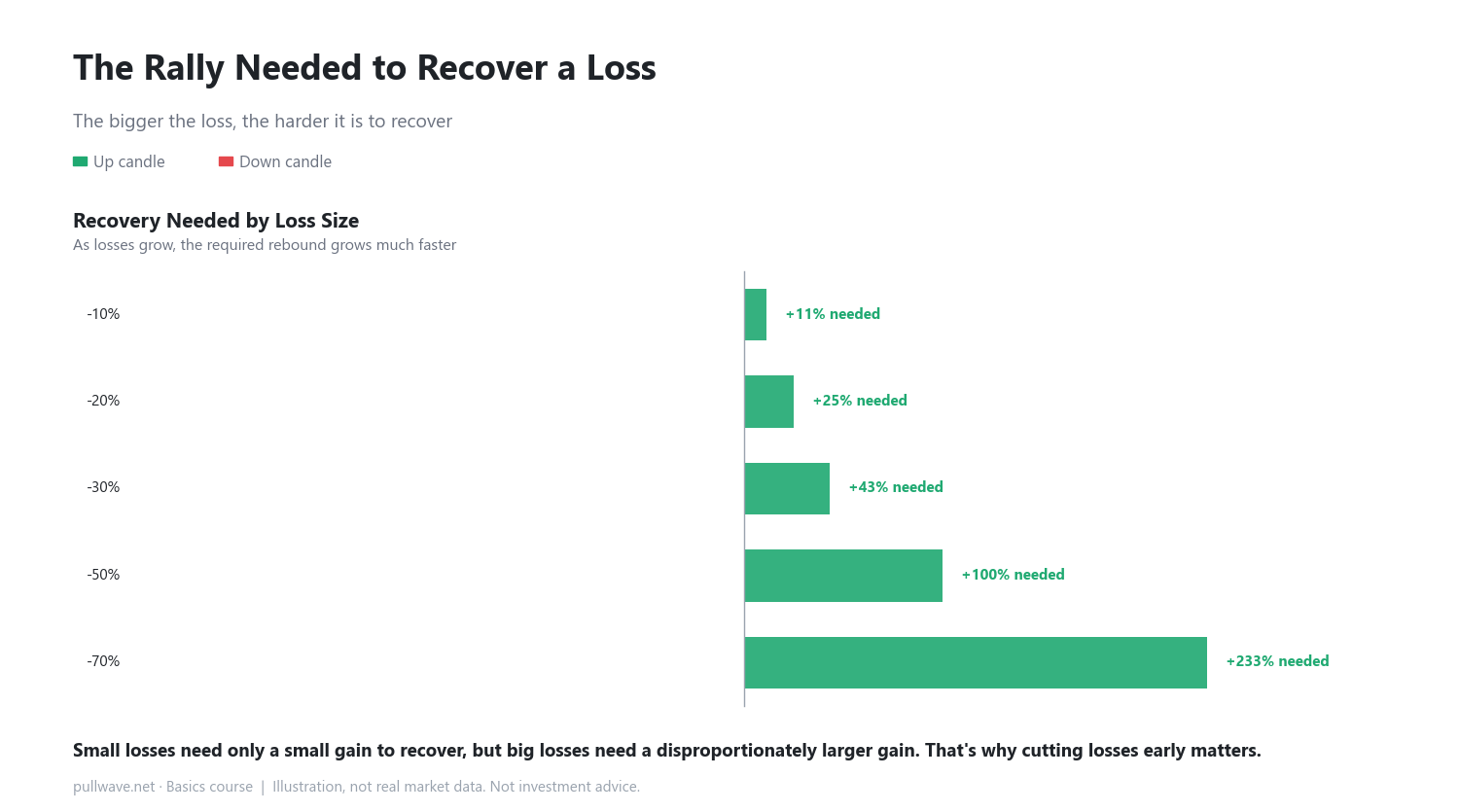
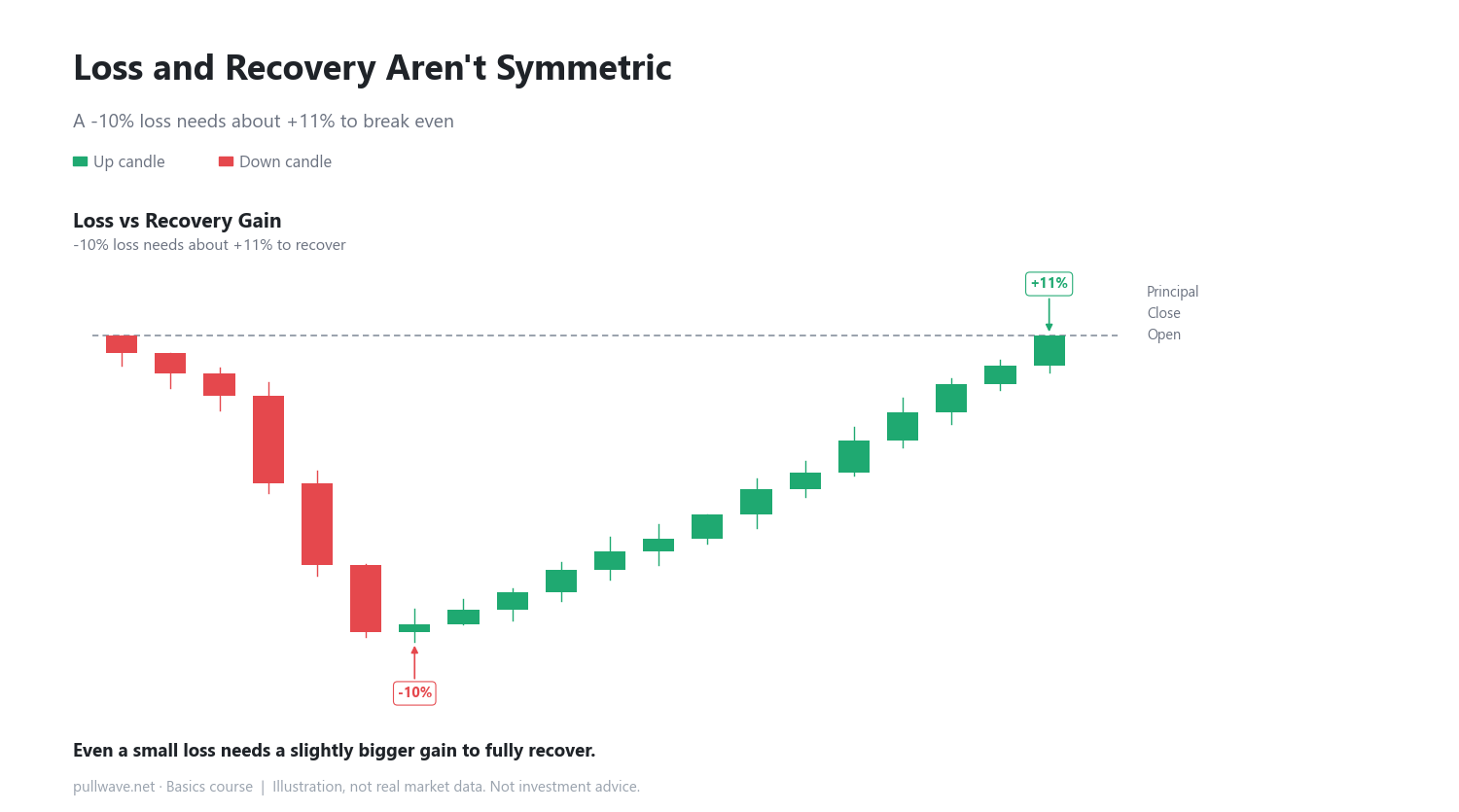
The percentage you lose and the percentage you need to gain back are not the same. If you lose 10% of 100, you have 90 left, and to get back to 100 you need an 11.1% gain from 90. The gap is small at first, but it widens dramatically as losses grow.
Doing the math by loss size
- -10% loss → need +11.1% to break even
- -20% loss → need +25%
- -30% loss → need +42.9%
- -50% loss → need +100% (price has to double)
- -70% loss → need +233%
The numbers alone show that recovery gets exponentially harder as losses grow. That's exactly why cutting a loss while it's still small is central to protecting an account.
What having a stop loss actually changes
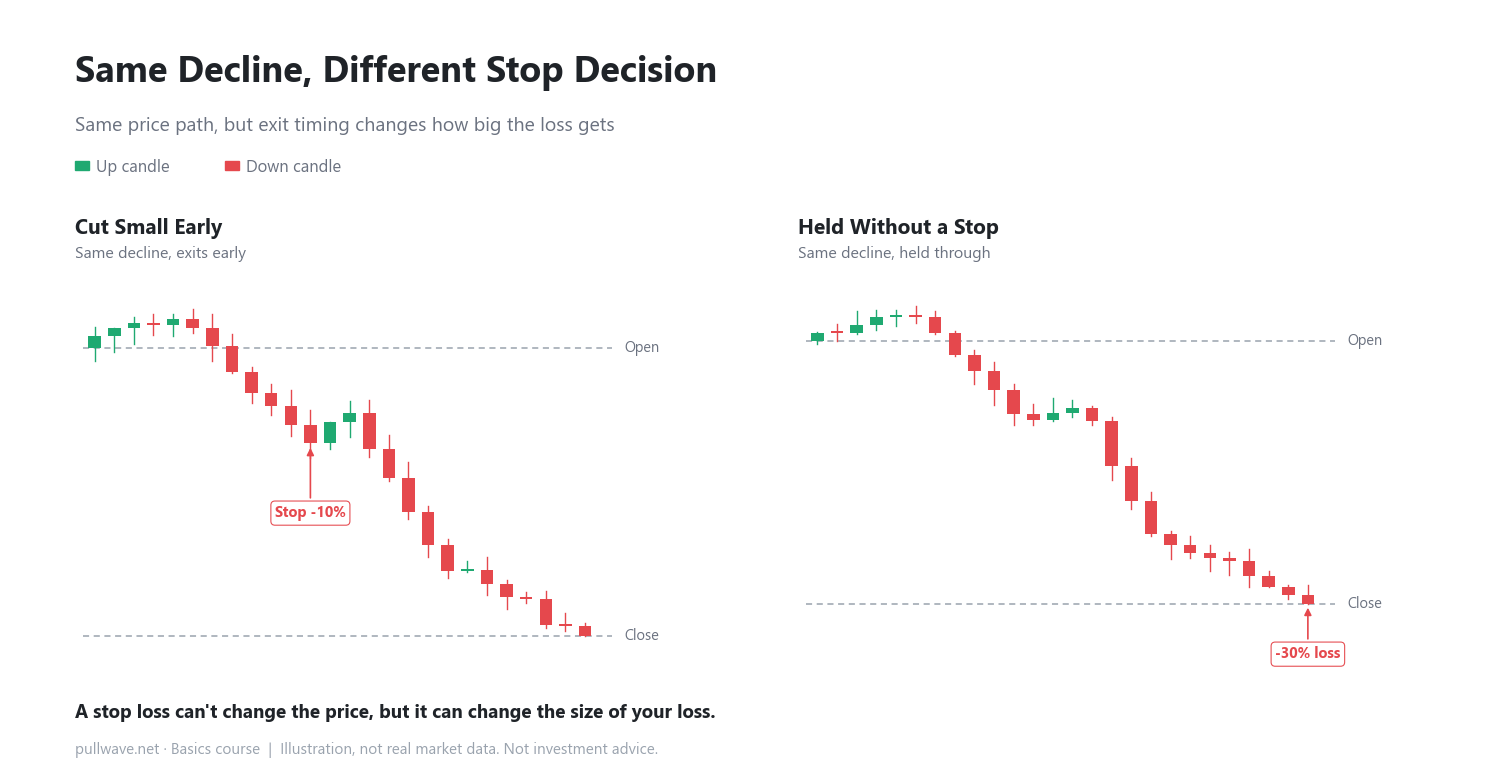
Given the exact same price path, where you choose to stop out completely changes your final loss. You can't control where price goes, but you can control how much of that move you're exposed to. Cutting a loss early keeps the required recovery small. Holding on without a stop lets the loss snowball, and recovery keeps slipping further out of reach.
The stop price is where you admit you were wrong
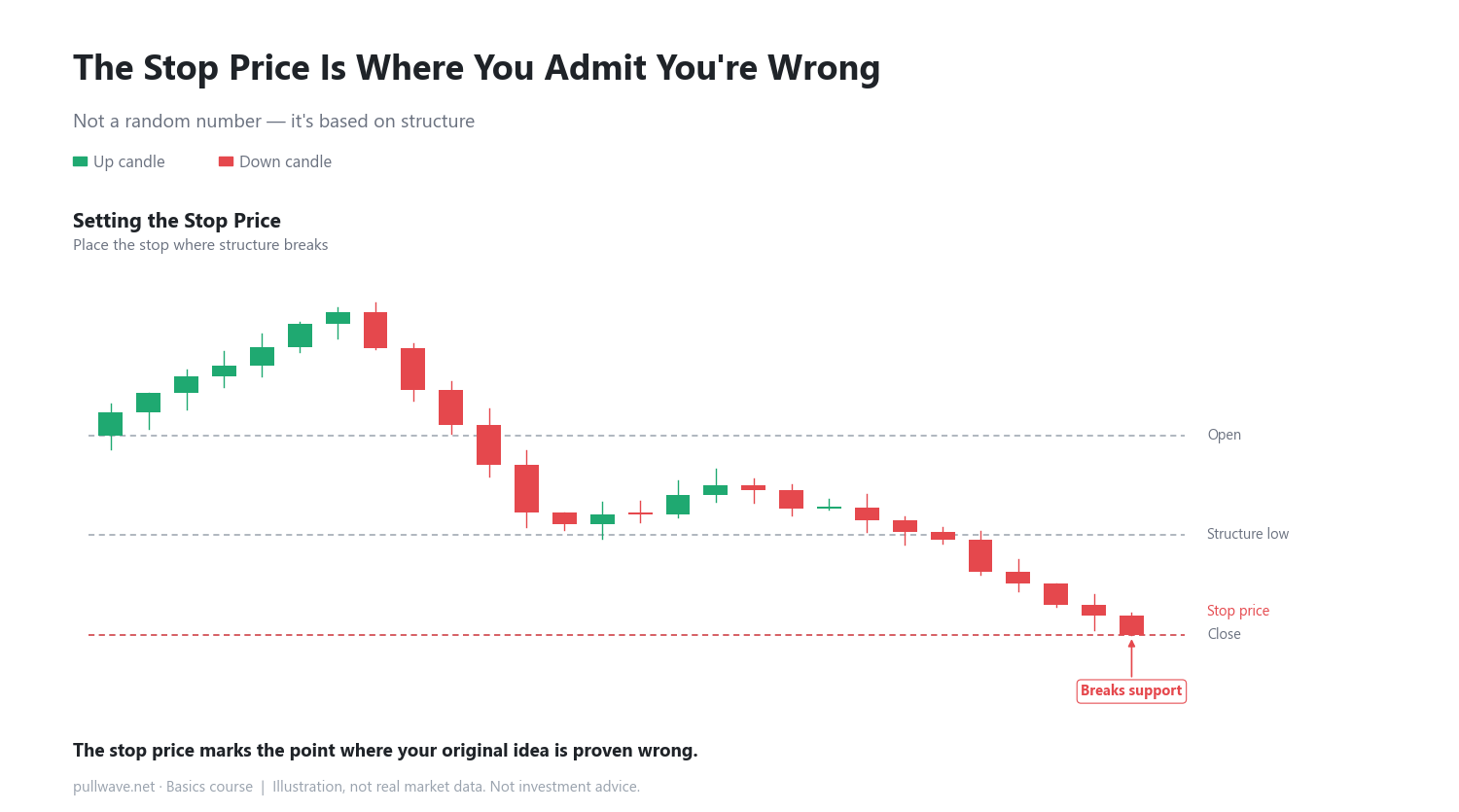
A common mistake is picking a stop price as just an arbitrary percentage, like "I'll stop at -5%" with no real reason behind it. A stop price should mean something: it's the price at which the scenario you entered on is no longer valid — in other words, the price where you admit your original read was wrong. For example, if you entered expecting a bounce above a support level, the moment that support breaks is the point where the scenario is invalidated. The next lesson digs deeper into exactly where to place that stop based on market structure.
How to use it on a real chart
On a real chart, decide your stop price before you open a position, then size the position based on the distance to that stop and how much loss your account can handle. Opening a position before deciding where you'll admit you're wrong is like starting to drive without a destination. Once you're in the trade, it also helps to avoid moving the stop around emotionally.
Common misconceptions
- A tighter stop isn't automatically safer. A stop placed too close can get triggered by normal price noise, creating frequent, unnecessary losses.
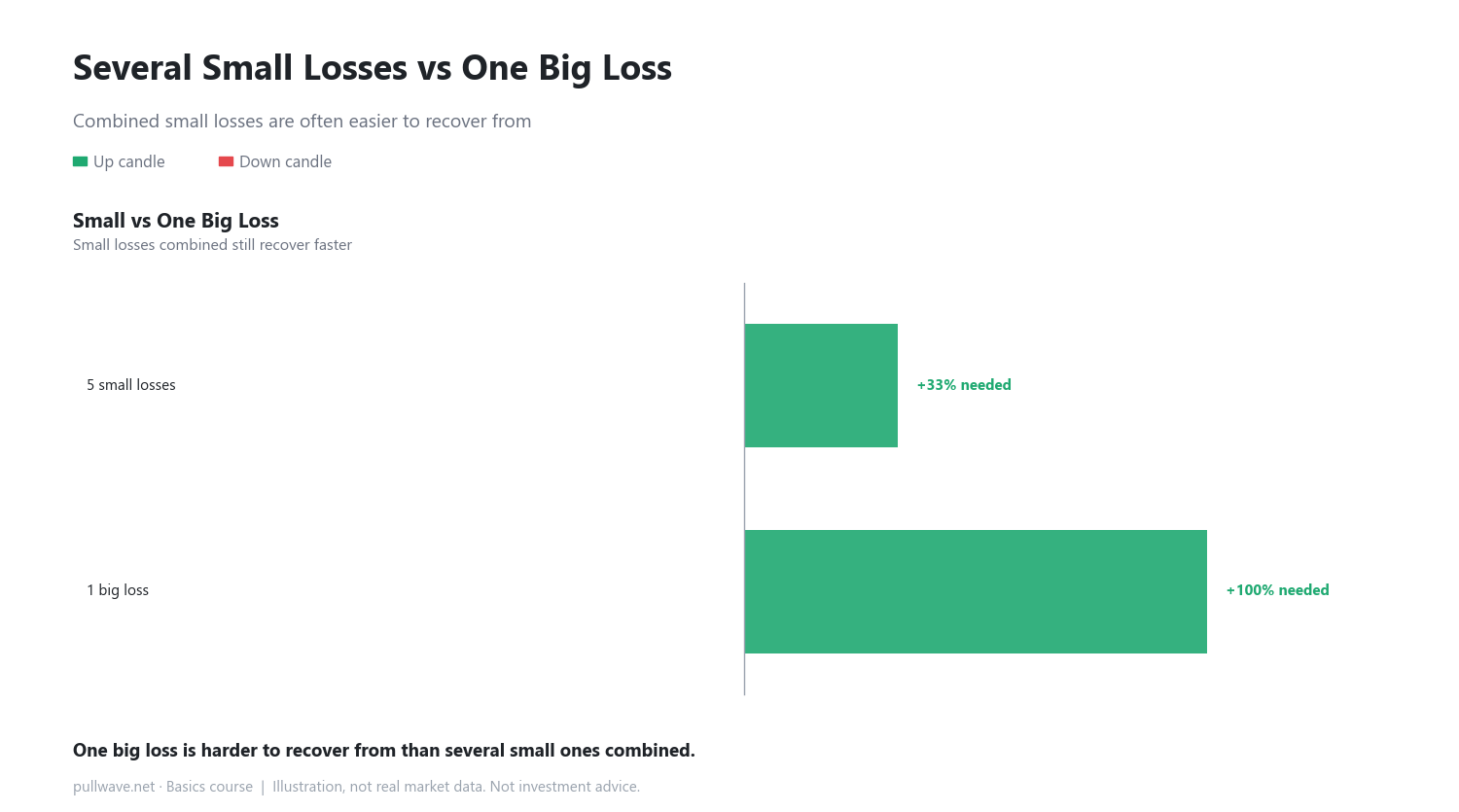
- Holding without a stop and hoping it recovers eventually is risky thinking. Several small losses added together are usually easier to recover from than one large loss left unchecked.
FAQ
Do I always need a stop loss?
Whenever you open a position, it helps to decide in advance where you'll exit if your idea turns out to be wrong. The exact method varies by situation, but holding a position with no predefined exit plan is generally not considered good risk management.
How wide should a stop be?
There's no single right answer. Stop distance is usually set based on market structure (like support or resistance areas) together with how much loss the whole account can tolerate. The next lesson covers how to set a stop based on structure in more detail.
General education, not investment advice. The picture is an illustration, not real market data.