Basics course · Lesson 13 · Part 2 · Reading candles
Marubozu Candles: One Direction, Start to Finish
At a glance
- A marubozu has a long body and almost no wick
- It means open=low/close=high (bullish) or the reverse (bearish)
- Chasing after it can leave you exposed to a pullback
In the last lesson, you learned that a doji — a candle with almost no body — means open and close ended up close together, a sign that buyers and sellers fought to a draw. Today we look at the opposite case: a candle with a long body and almost no wick, called a marubozu (Japanese for "bald head," because it has no "hair," or wick).
As a quick refresher, every candle is built from four numbers: the open (price when the period started), the close (price when it ended), the high (highest price reached), and the low (lowest price reached). The body is the thick rectangle between open and close. The wicks (or shadows) are the thin lines above and below the body, and they only appear when the high or low is different from the open or close.
What a marubozu tells you
Almost no wick
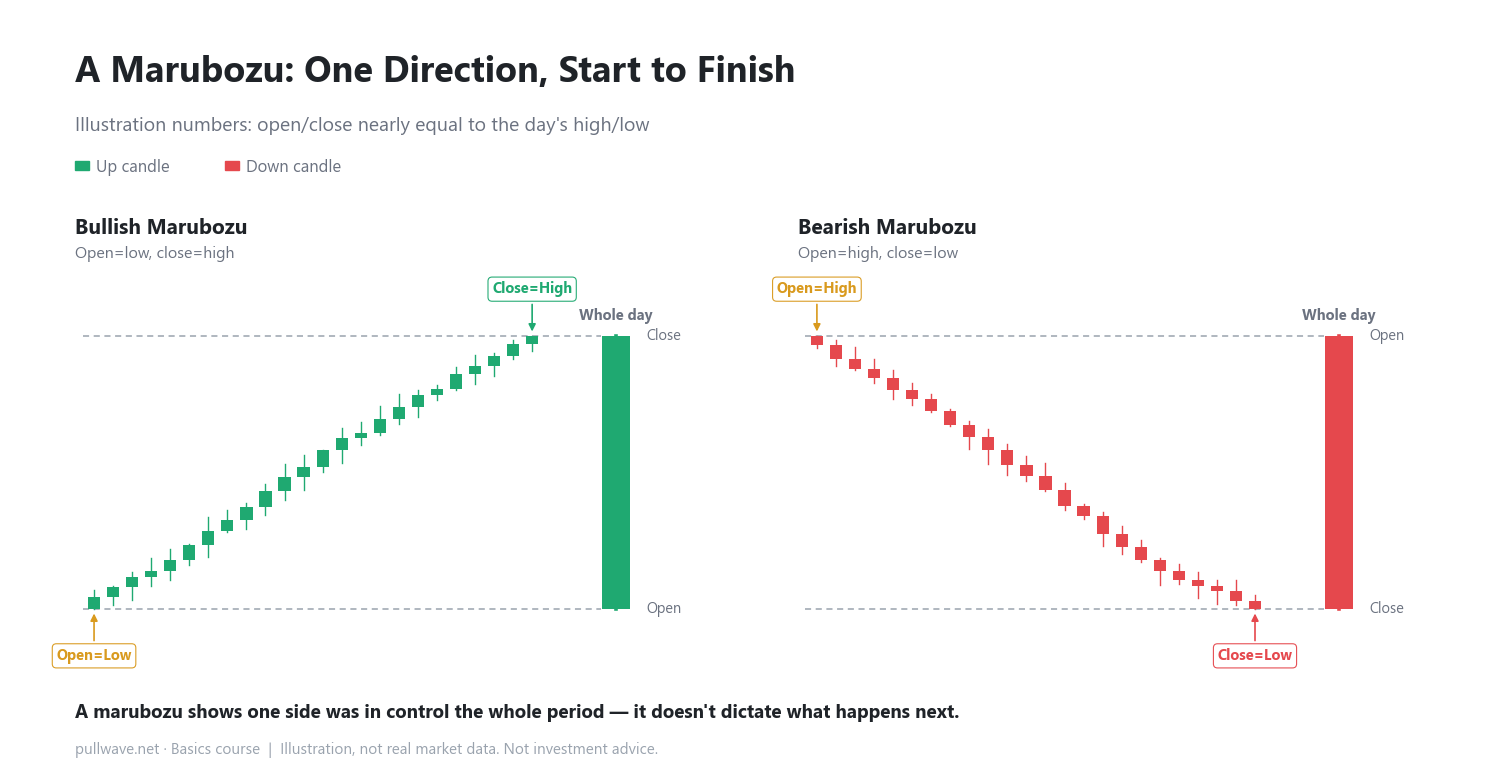
A marubozu has a very long body and barely any wick on either end. In a bullish (up) marubozu, the open is almost identical to the low of the period, and the close is almost identical to the high. In other words, one side — buyers, in this case — took control right from the start and kept that control, with almost no pullback, all the way to the close. A bearish (down) marubozu is the mirror image: the open is almost the same as the high, and the close is almost the same as the low, meaning sellers pushed the price down from the opening and kept pushing until the close.
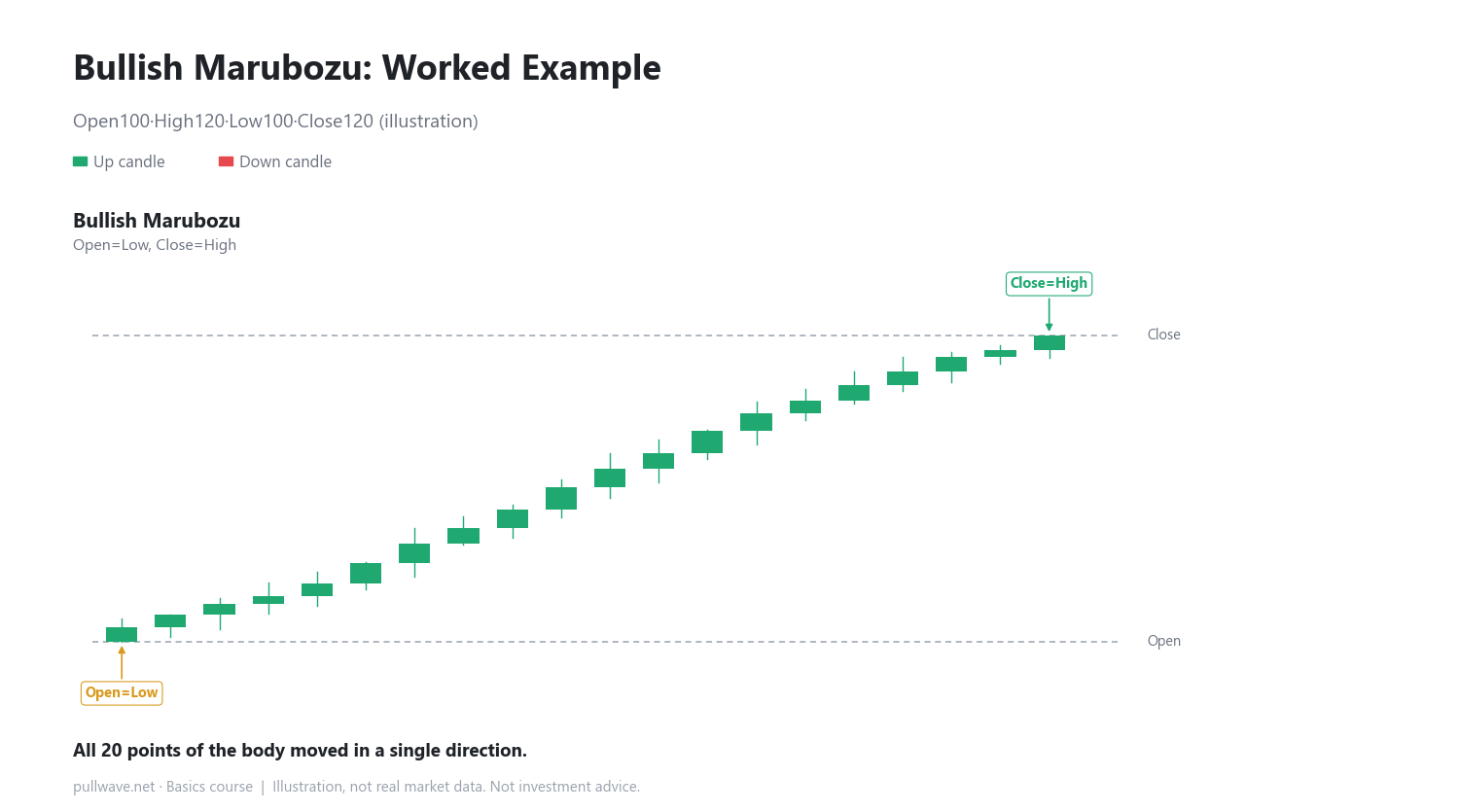
Take this illustration: open 100, high 120, low 100, close 120. The low equals the open, and the high equals the close, so there is effectively no wick at all. The body size is 120 minus 100 equals 20 points, and that entire distance was covered in a single direction.
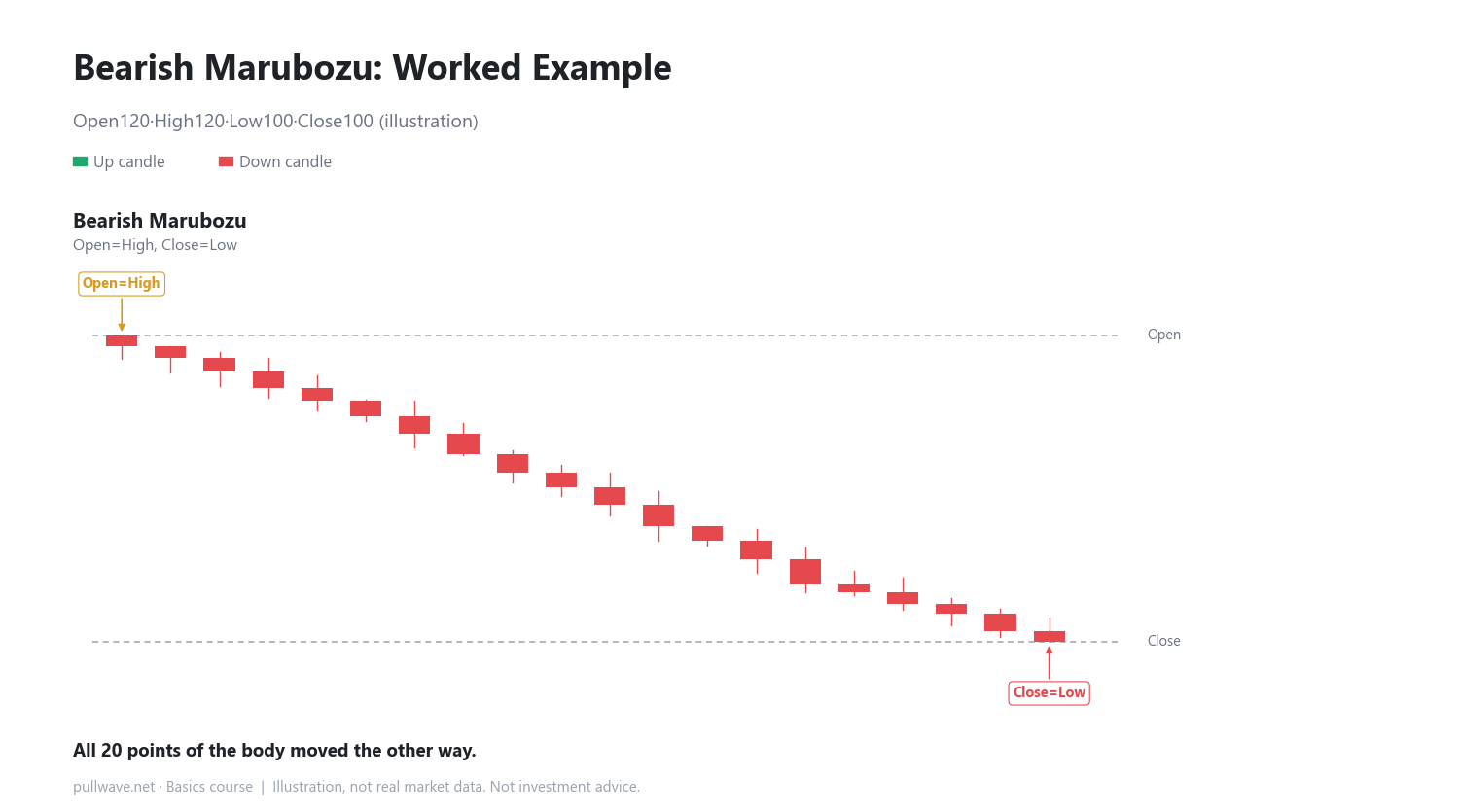
Flip the numbers around — open 120, high 120, low 100, close 100 — and you get a bearish marubozu: price opened at its high for the period and was pressed down all the way to the low by the close.
What commonly happens next, and the risk of chasing
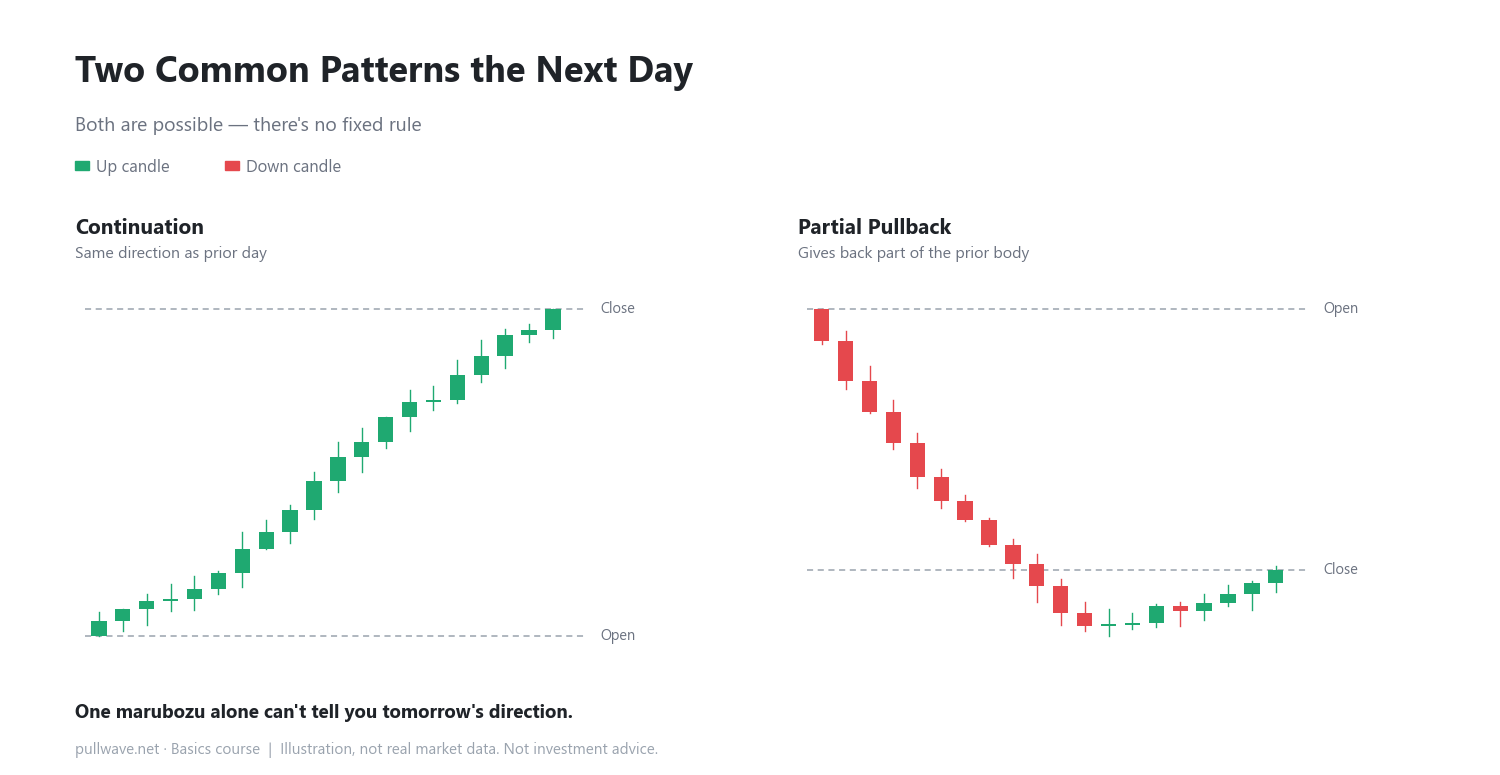
There is no fixed rule for what happens right after a marubozu. Price can keep moving the same way, it can pause and barely move, or it can retrace part of the previous move. The point isn't that one of these always happens — it's that all three are realistic possibilities.
This is where "chasing" comes in. Chasing means entering a position in the same direction only after a big move has already happened, based on seeing that move. The problem is that the close of a marubozu already sits at a price that has moved a lot in the short term. If you enter right there, and the next period brings a partial retracement, you can easily end up holding a position at a worse price than where you entered.
How to use it on a real chart
When you spot a marubozu on a real chart, it helps to check three things together. First, the ratio of body to wick — the smaller the wick, the stronger the sign that one side was in control without interruption. Second, the higher timeframe — for example, if several 15-minute candles combine into a 1-hour candle that itself looks like a marubozu, that means the whole hour moved in one direction without a meaningful pullback (this connects back to the higher/lower timeframe relationship from lesson 11). Third, remember that a marubozu only tells you how strongly one side dominated during that period — it does not tell you what comes next.
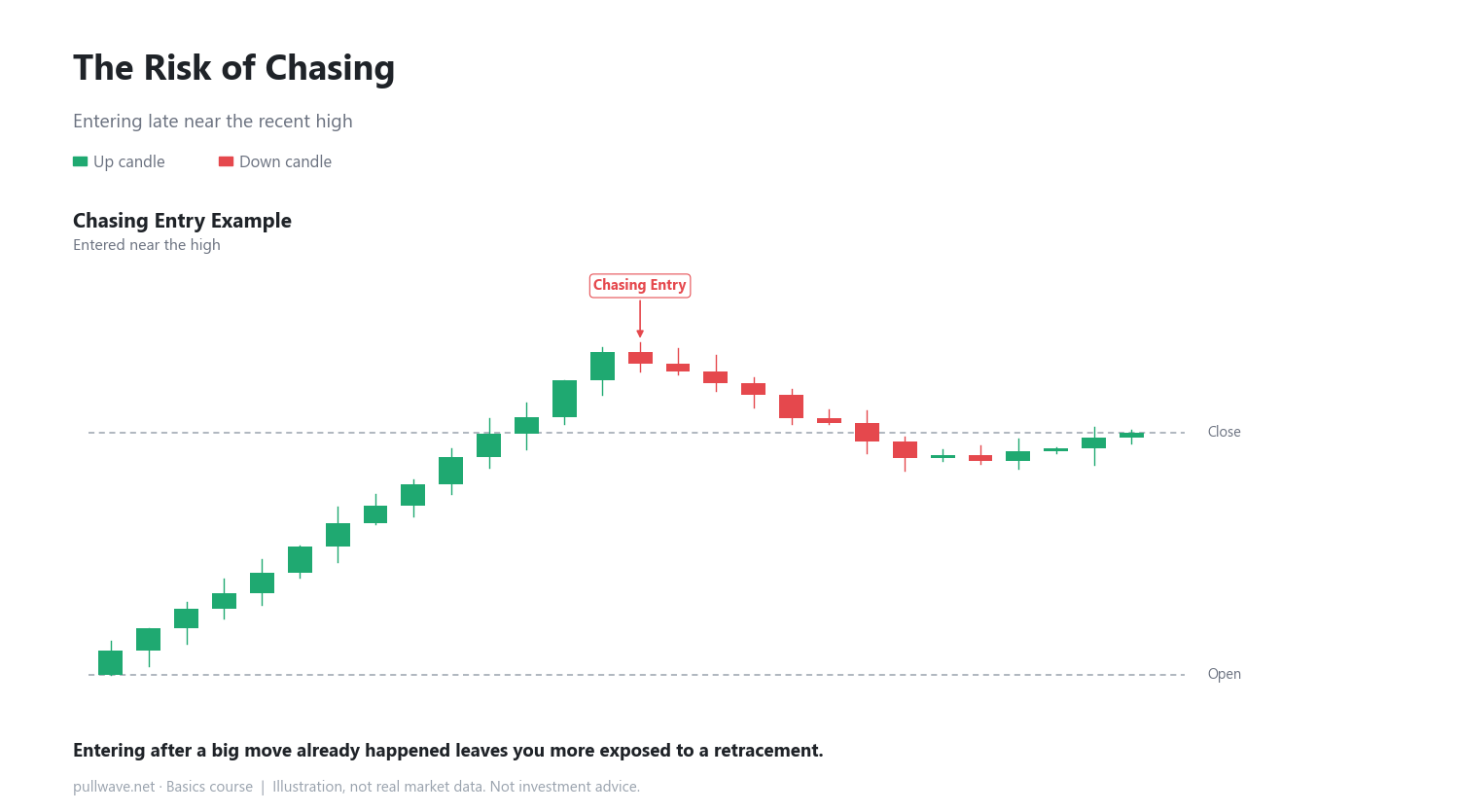
So rather than jumping in late after seeing a marubozu, it's better to build the habit of weighing the body-to-wick ratio, the higher-timeframe context, and your own risk management rules (covered in detail in a later lesson) together.
Common misconceptions
- "A marubozu means the next period will move the same way." A marubozu only shows how one-sided the previous period was — it is not a formula for predicting the next period's direction.
- "A true marubozu must have zero wick." In practice many marubozu candles have a tiny wick; what matters is that the body takes up an overwhelming share of the full candle range.
FAQ
Does a marubozu mean the same thing on every timeframe?
The core idea — almost no wick means one side stayed in control the whole period — applies on any timeframe. But a 1-minute marubozu and a daily marubozu carry different amounts of information; a daily marubozu compresses an entire day's action into one candle, so traders often treat it as more significant.
Does price always pause after a marubozu?
No. It can pause, keep going, or partially reverse. Relying on a single candle to decide what happens next is risky — it's safer to look at several signals together.
General education, not investment advice. The picture is an illustration, not real market data.