Basics course · Lesson 5 · Part 1 · Trading basics
Higher Leverage Means a Closer Liquidation Price
At a glance
- Liquidation is the exchange automatically closing your position once your margin runs out.
- The higher the leverage, the smaller the adverse price move needed to reach liquidation.
- Fees and maintenance margin make the real liquidation distance closer than the simple estimate.
In the previous lesson, we looked at leverage and margin. Using leverage lets you control a larger position with a smaller amount of your own money, but it also makes the price range your margin can absorb much narrower. Today we'll put numbers on that narrowing range — the "distance to liquidation."
Liquidation is when your margin can no longer absorb further losses, so the exchange closes your position for you automatically. You don't choose when it happens — the exchange's system does it based on your margin and the current price, regardless of what you want to do next.
Higher leverage, shorter distance
A rough way to estimate the distance
With leverage, your margin is your own money, and the exchange effectively lends you the rest to size up the position. Liquidation happens roughly where your margin has been wiped out by losses. As a very rough estimate, the price move you can survive before liquidation is about "100% ÷ leverage multiple."
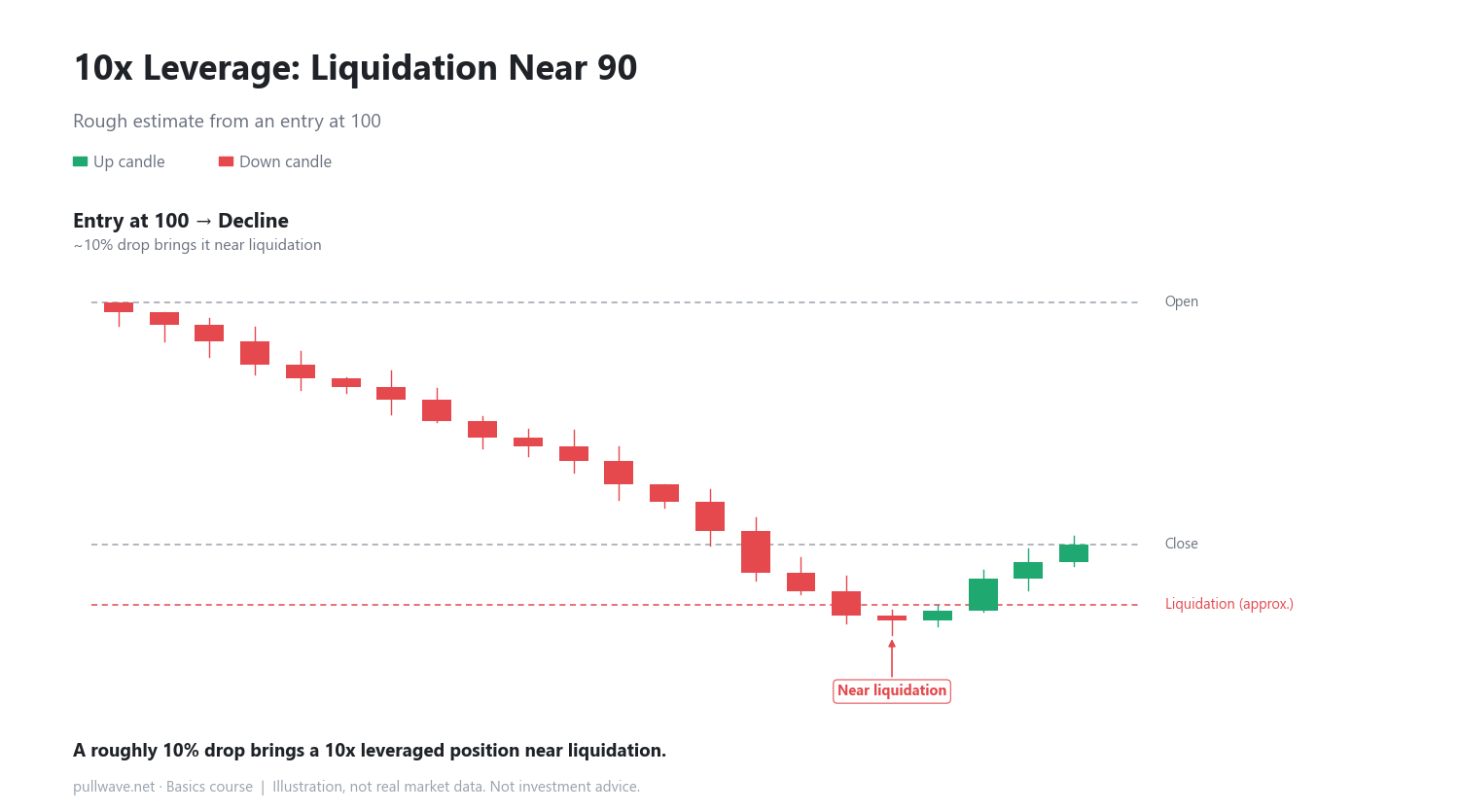
For example, say you open a position at a price of 100 using 10x leverage. Roughly, 100% ÷ 10 = 10%, so if the price moves about 10% against you (down near 90), your margin is close to being used up and you're near liquidation.
Comparing across leverage levels
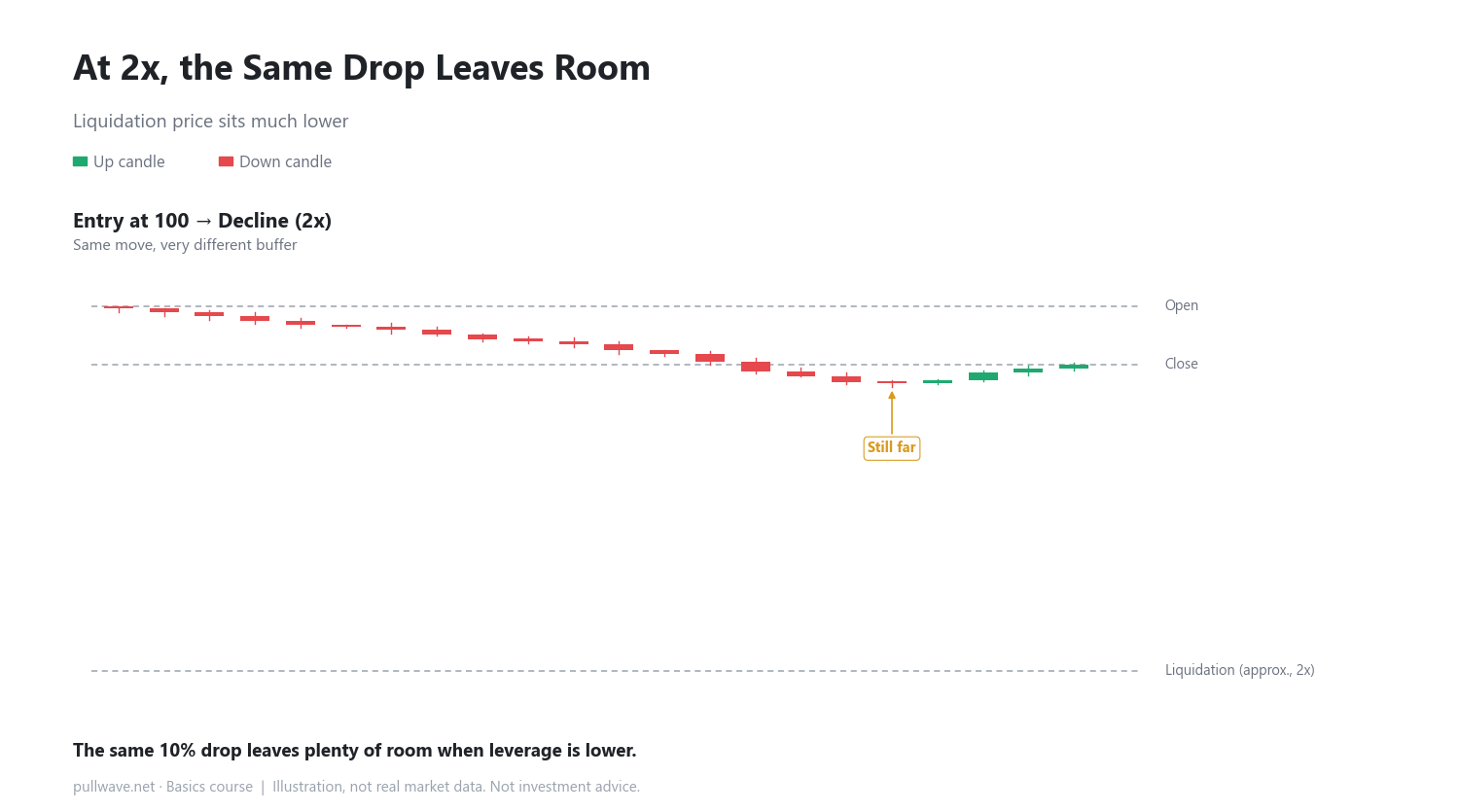
Now imagine the same setup but with 2x leverage instead. Roughly, 100% ÷ 2 = 50%, meaning the price would need to move about 50% against you before you're near liquidation. If the price drops 10% in both cases, the 2x position still has plenty of room left, while the 10x position is already close to the edge.
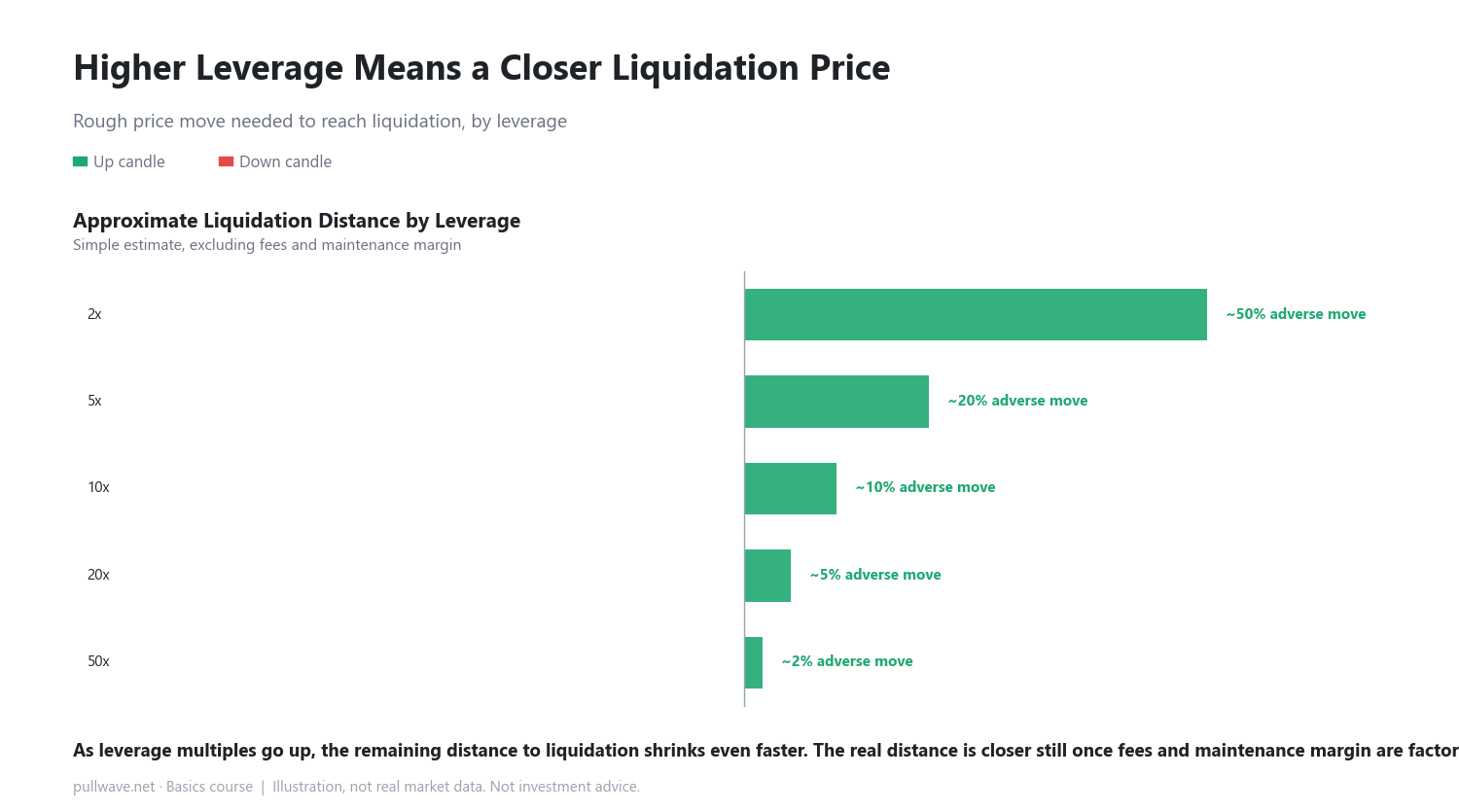
Lining this rough estimate up across leverage levels, as in the chart above, 2x gives you roughly 50%, 5x roughly 20%, 10x roughly 10%, 20x roughly 5%, and 50x roughly 2%. The distance shrinks very quickly as leverage goes up.
Actual distance is even closer
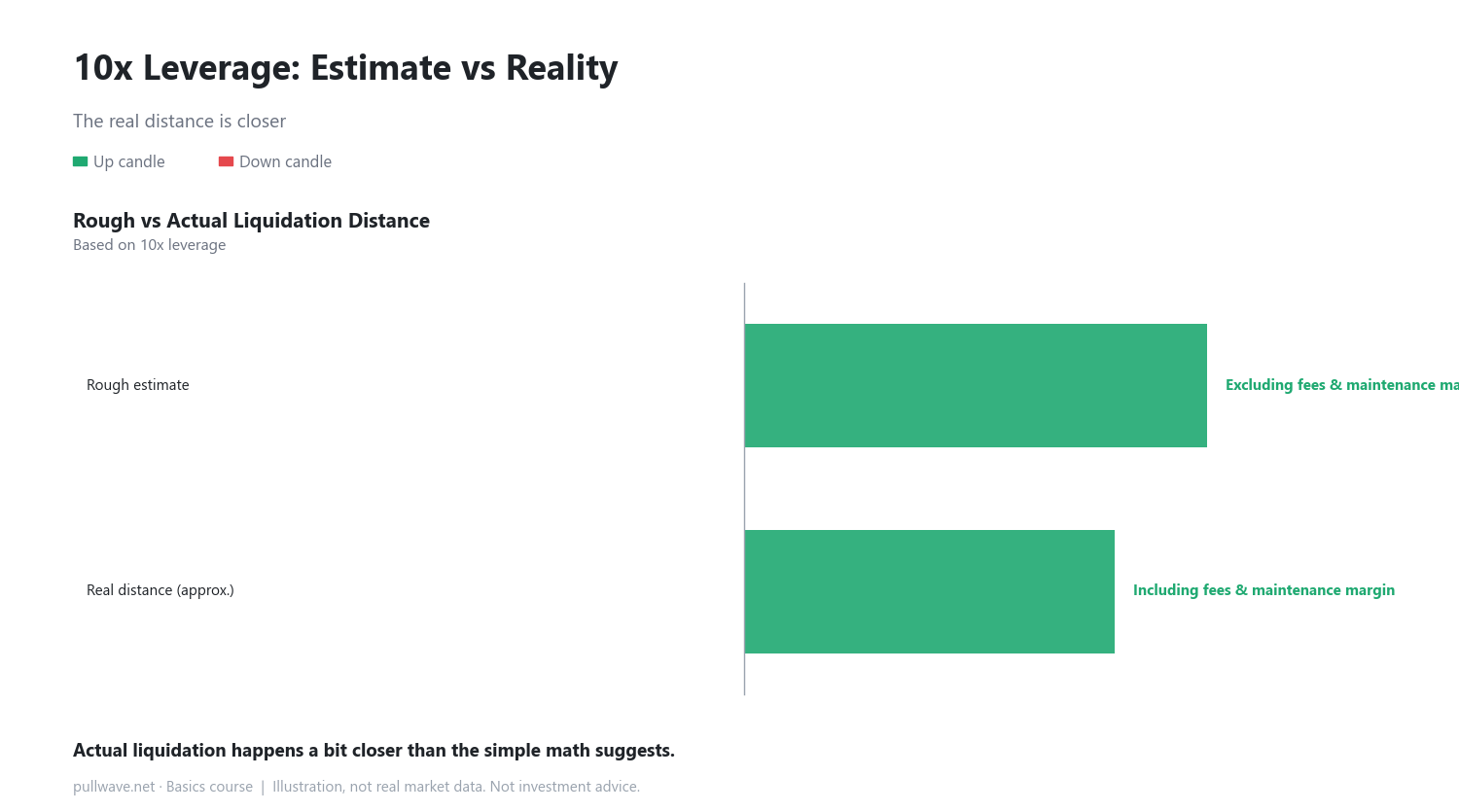
That rough calculation ignores fees and maintenance margin — the minimum margin level the exchange requires you to keep while holding the position. In practice, maintenance margin requirements and trading fees eat into your buffer, so your real liquidation price sits a bit closer than the simple estimate. For example, if the rough estimate for 10x leverage was about 10%, the actual liquidation might happen somewhere around 8-9%.
How to use it on a real chart
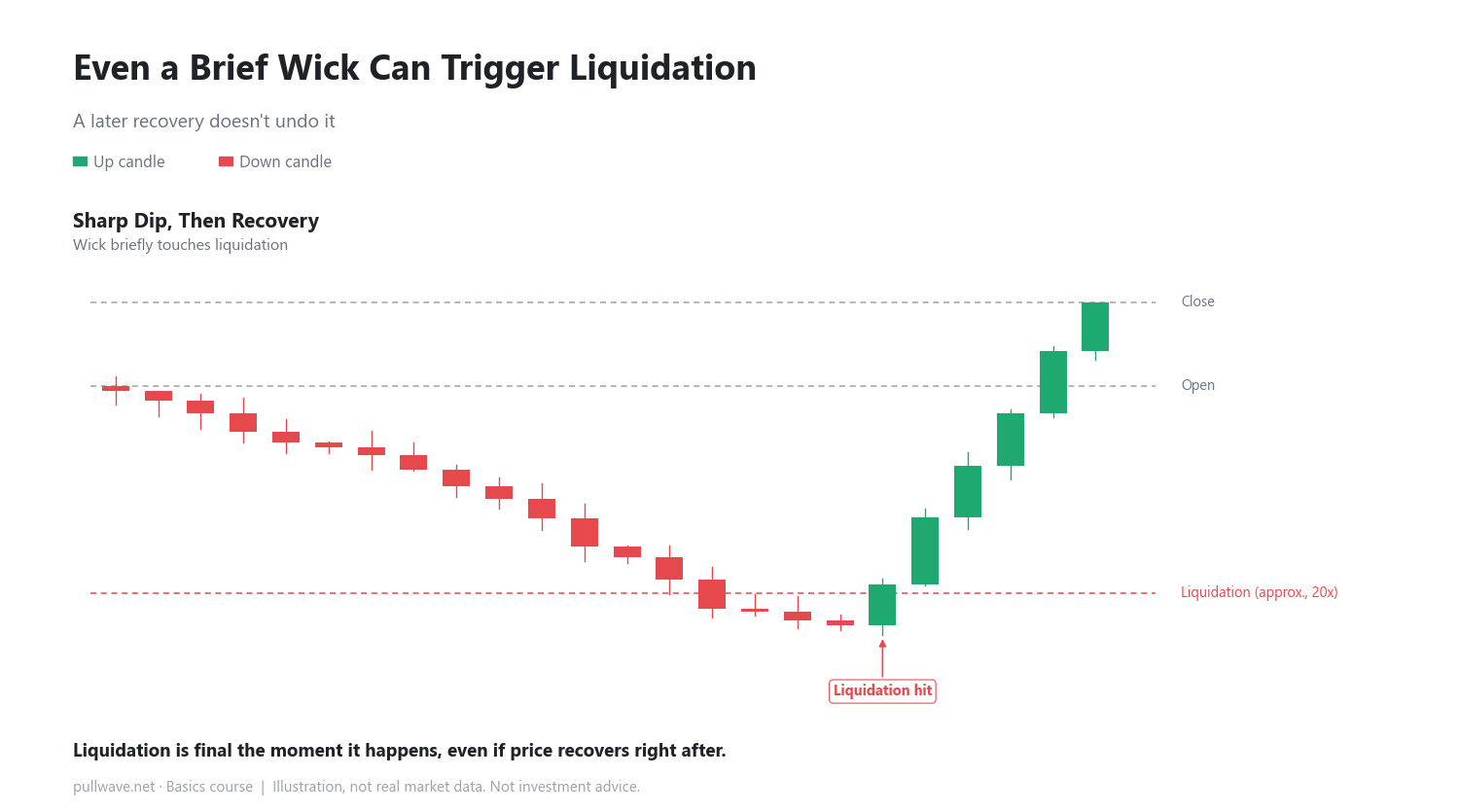
On real charts, price often doesn't fall in a straight line — it can print a single long wick down and bounce back within minutes. The problem is that if that wick even briefly touches your liquidation price, your position is already closed. It doesn't matter that price recovers a moment later — liquidation is final once it happens. This is why, the higher your leverage, the more you need to account for short-term volatility (wicks), not just the "average" move, and leave yourself extra room.
Common misconceptions
- "As long as my liquidation price is far away, I'm fine": maintenance margin and fees mean the real distance is closer than the simple estimate, so you need extra buffer.
- "It's okay if price bounces back quickly": even a brief touch of your liquidation price closes the position at that moment — a later recovery doesn't undo it.
FAQ
Is the liquidation price calculated the same way on every exchange?
The general framework (leverage, maintenance margin ratio) is similar, but exact fee structures and maintenance margin ratios differ by exchange and by product. Always check the exact calculation method used by the platform you actually trade on.
Does lowering leverage remove liquidation risk completely?
Lowering leverage increases your distance to liquidation and reduces risk, but it doesn't eliminate it. An extreme enough price move can still cause liquidation even at low leverage.
General education, not investment advice. The picture is an illustration, not real market data.