Basics course · Lesson 1 · Part 1 · Trading basics
Spot vs. Futures: What's the Real Difference?
At a glance
- Spot trading means owning the actual coin; profit only comes if the price rises above your buy price.
- Futures let you take a long or short position on price direction without owning the coin itself.
- Futures involve margin and liquidation, concepts that spot trading does not have.
If you're new to crypto, you've probably heard "spot" and "futures" used as if they were the same thing. They are not. Spot trading means you buy and hold the actual coin. Futures trading means you hold a contract tied to the coin's price, without ever owning the coin itself. This single difference is the foundation for almost everything else in this course, including margin and liquidation, which later lessons build on.
Core idea
Spot: you own the coin
When you buy spot, you exchange cash for the coin itself. The coin sits in your wallet or account, and its value moves with the market price. You make a profit only if the price rises above what you paid, and you lose if it falls below that price. Because a coin's price can't go below zero, your loss is capped at the amount you originally paid — you never owe more than that.
Futures: you own a contract, not a coin
A futures contract is an agreement about where the price is headed, not a claim on the coin itself. This opens up a second option that spot trading doesn't have: you can take a "long" position, which profits if the price rises, or a "short" position, which profits if the price falls. To open either position, you put up collateral called margin. If the price moves far enough against your position, the exchange can automatically close it — this is called liquidation, and it means a position can be closed faster than a spot holder's paper loss would ever force a sale.
Worked example
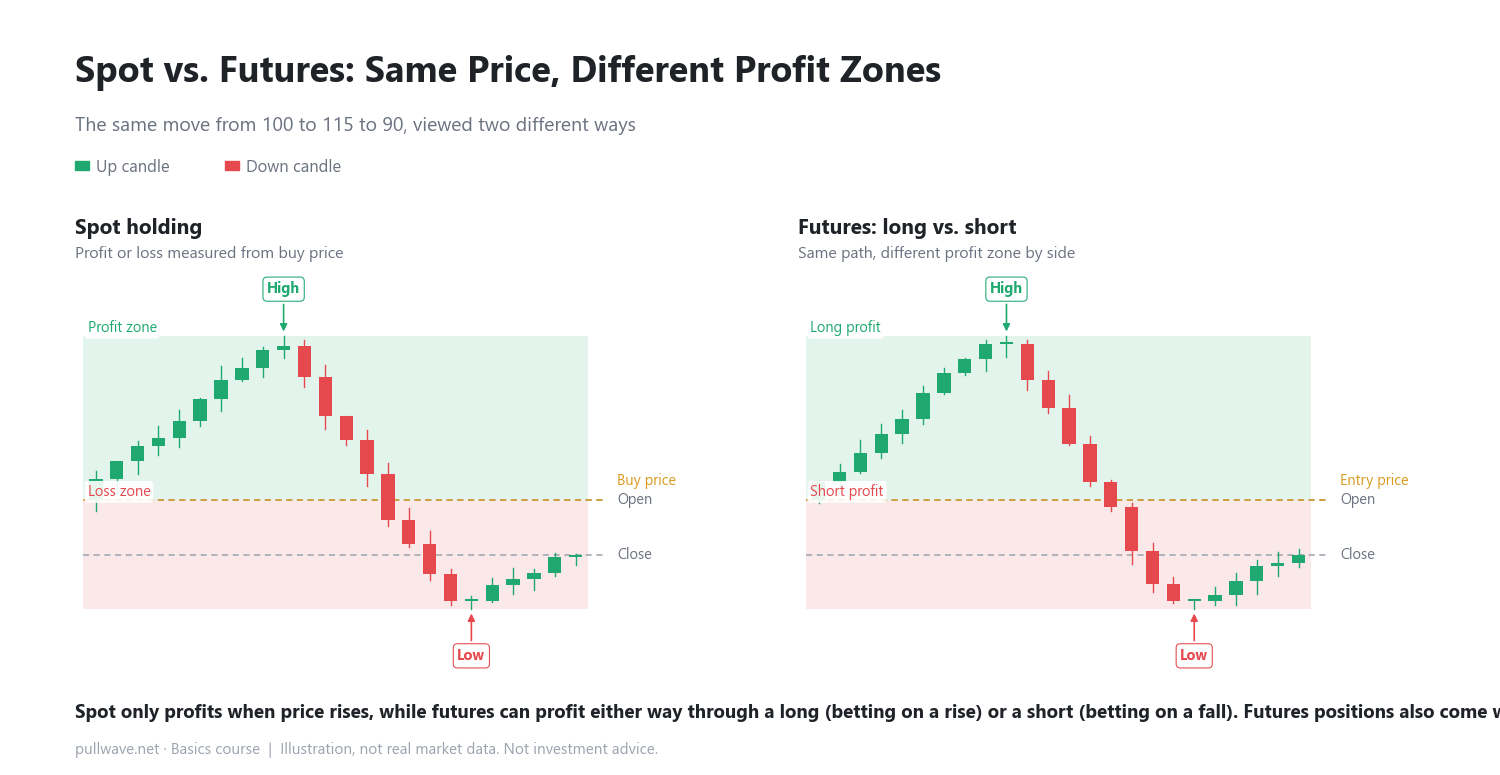
Say the illustration price starts at 100. If you buy spot at 100 and the price rises to 115, you have a paper gain of 15 per coin; if it falls to 90 instead, you have a paper loss of 10, but you still hold a coin worth 90 — nothing is forced to happen. Now compare futures: if you open a long at 100 and price rises to 115, you gain 15 per contract, similar to spot. But if you had opened a short at 100 instead, that same rise to 115 would be a loss, while a fall to 90 would be a gain of 10. Direction matters, and so does the margin backing the position.
How to use it on a real chart
Look at the two panels in the illustration. Both show the exact same price path: up from 100 to a high around 115, then down to a low near 90. In the spot panel, there's only one profit zone, above the buy price, and one loss zone, below it. In the futures panel, the same path creates two possible profit zones depending on which side you took: the zone above entry rewards a long, and the zone below entry rewards a short. When you check a real chart, ask yourself which panel matches what you're actually holding — a coin, or a directional contract — before you think about the price move itself.
Common misconceptions
- Futures are not just "a quicker way to buy coins." They are a separate type of contract with their own mechanics, including margin and liquidation.
- Holding spot isn't always the safer choice either — it still carries full exposure to price swings; it simply skips margin calls and forced closures.
FAQ
Can I lose more money than I put in with spot trading?
No. Since a coin's price can't fall below zero, the most you can lose on a spot purchase is the amount you originally paid for it.
Does trading futures always mean using high leverage?
No. Leverage and the long/short mechanic are separate ideas. You can hold a futures position with little or no added leverage; the defining feature of futures is the contract structure itself — holding a bet on direction rather than the coin — not the leverage level. Later lessons cover leverage and liquidation in detail.
General education, not investment advice. The picture is an illustration, not real market data.